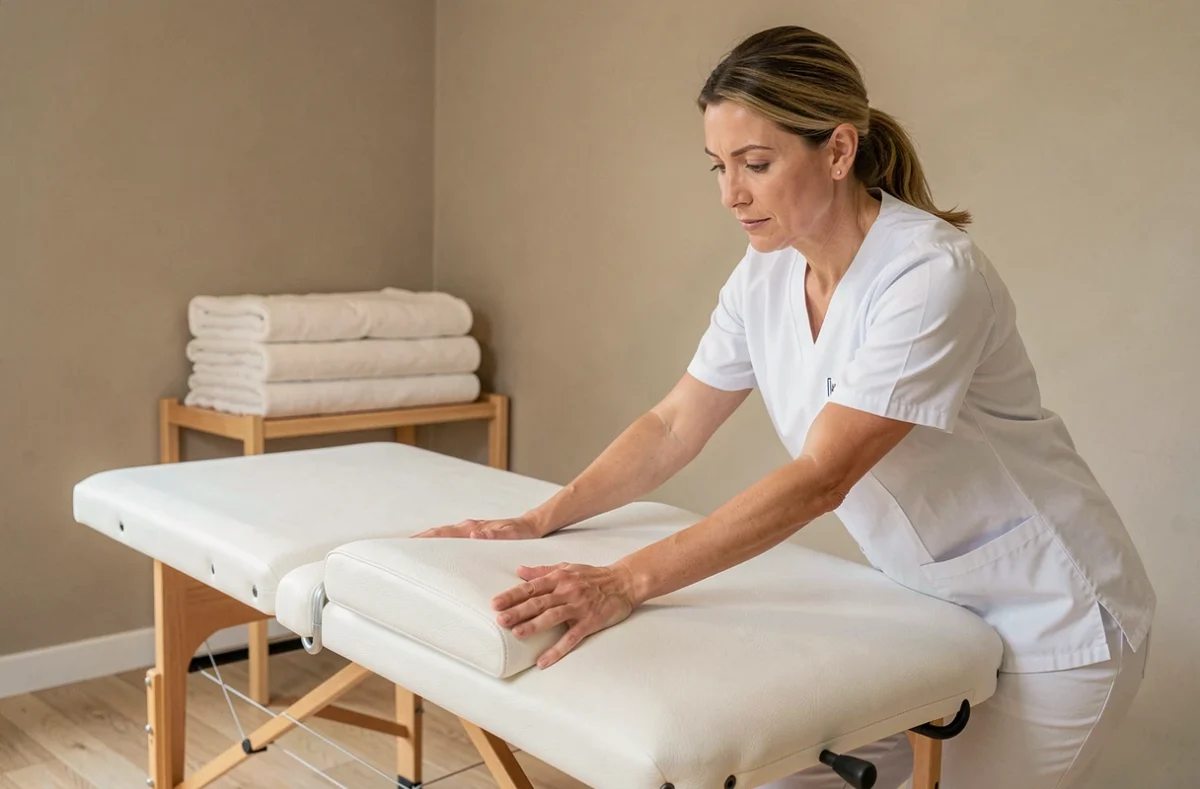
A physiotherapist who performs twelve sessions a day puts different demands on a table than a shiatsu practitioner working on the floor with an auxiliary futon.
Choosing a professional massage table comes down to very practical considerations: how often it needs adjusting, how well it withstands repeated pressure, how easy it is to clean between clients and, for mobile practitioners, how much it weighs to carry. Before comparing spec sheets, identify the movements you repeat every day and the situations that wear out your equipment.
Test a massage table in real-world conditions before buying
A manufacturer’s listed specifications (height, weight, load capacity) tell only part of the story. A table advertised as “height-adjustable” may require a lengthy or noisy adjustment, making it unsuitable for a tightly scheduled series of appointments.
We recommend recreating a typical workday during a trial. Adjust the height several times in a row, simulate prolonged lateral pressure, and check that the table doesn’t slide on a smooth floor. Repeatedly testing the adjustment reveals how robust the mechanism is far better than a product sheet can.
For shared workstations, INRS recommends easily adjustable work surfaces when users have different body types. This guidance applies directly to a practice where several practitioners take turns using the same equipment: a hydraulic or gas-lift adjustment system that can be operated with one hand and without tools saves time and protects practitioners’ joints.
One point that’s often overlooked during a trial is stability during deep-pressure techniques. You press firmly on one spot, shift your weight, and the table must neither tip nor creak. This is the kind of flaw you won’t spot in a store by simply placing your hand on the tabletop. To help guide this kind of decision, the professionals at La Table De Massage offer guides tailored to different practices.
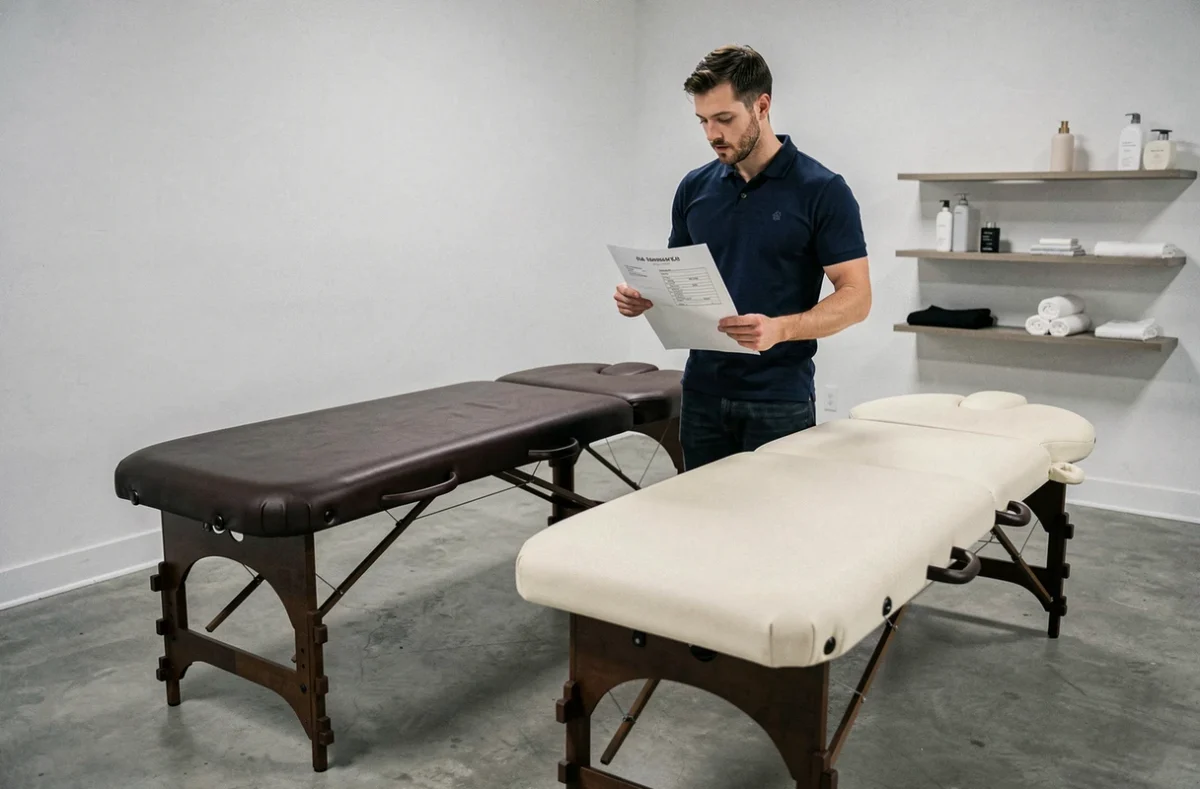
Cleaning and maintaining the upholstery between sessions
The tabletop is cleaned between clients. But adjustment levers, the headrest, armrests and carrying straps are frequently touched surfaces that many practitioners overlook in their hygiene routine.
The disinfectant must be compatible with the table upholstery. A product that’s too harsh can damage faux leather within a few months, causing cracks, discoloration and loss of water resistance. The contact time specified on the disinfectant label matters too: wiping it off immediately reduces its effectiveness without offering any extra protection for the upholstery.
Damaged upholstery is more than a cosmetic issue. Cracked surfaces are difficult to disinfect properly because bacteria can lodge in the micro-cracks. The manufacturer’s documentation will generally specify whether a component should be repaired, replaced or taken out of service. Checking the condition of the upholstery is part of routine maintenance, just like cleaning the table itself.
- Choose thick PU or PVC upholstery with welded rather than sewn seams to limit disinfectant from seeping in.
- Always clean secondary contact areas (levers, headrest, support bar) after every session, not just the tabletop.
- Keep the manufacturer’s instructions to check which products are compatible and when the upholstery should be replaced.
Portable massage table: balancing weight and load capacity
For practitioners who travel to clients’ homes or workplaces, table weight becomes a daily consideration. You take it out of the trunk, carry it up stairs, and unfold it in a living room or meeting room. Every extra kilo takes a toll on the practitioner’s back by the end of the week.
The problem is that reducing weight often means reducing load capacity or tabletop width. Feedback from practitioners on specialist forums describes this trade-off: a very lightweight aluminum table works well for relaxation massages, but lacks stability for deep-tissue techniques with larger clients.
The right question isn’t “What’s the lightest table?” but “What’s the maximum weight I’m willing to carry while still maintaining enough stability for my practice?”
Factors to weigh when choosing a portable table
- Tabletop width: a narrow tabletop (around 60 cm) makes the table lighter but limits comfort for clients with broad shoulders. A wider tabletop provides better stability for lateral pressure.
- Frame material: aluminum reduces weight, while wood (especially solid beech) offers greater rigidity under load. Some manufacturers combine the two.
- Folding system: a bi-fold design is the most common, but hinge quality determines how long it will last. Steel hinges with positive locking hold up better to repeated opening and closing.
- Carrying case: a case with wheels or backpack straps can make a dramatic difference to everyday portability.
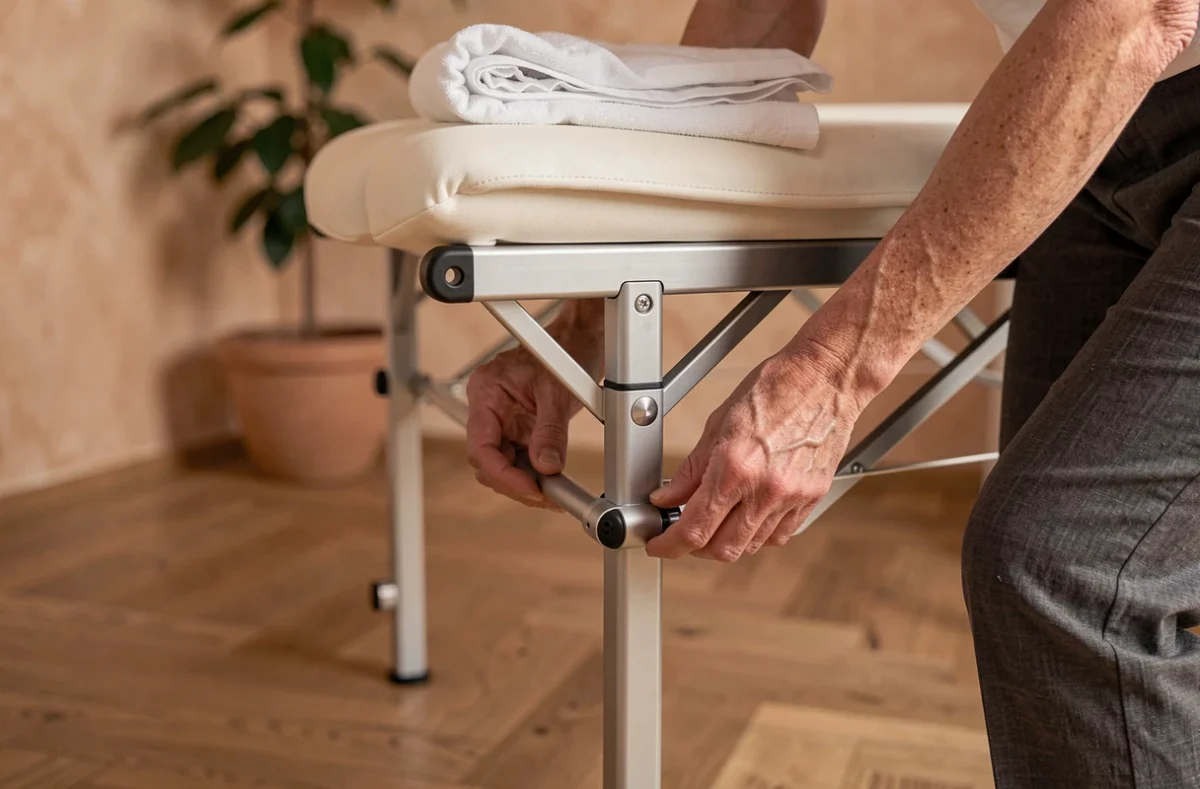
Table height and preventing practitioner pain
There’s plenty of discussion about client comfort, but rarely about the therapist’s. Table height determines your working posture throughout the session. If it’s too high, you have to raise your shoulders. If it’s too low, you have to bend forward at the lower back for extended periods.
Adjusting the table to suit the practitioner’s build helps reduce chronic back and shoulder pain. A general rule of thumb is to set the tabletop at wrist height when standing with your arms at your sides. However, this varies depending on the technique: deep Swedish massage calls for a lower table so you can use your body weight, while lymphatic drainage is more comfortable on a higher table.
In a shared practice, the table needs to be adjusted quickly between practitioners of different heights. A rack-and-pinion system with several preset positions allows adjustment in seconds and with little effort. Hydraulic systems offer continuous, more precise adjustment, but cost considerably more.
Choosing a professional massage table isn’t just a matter of comparing specifications. It’s an everyday work tool whose shortcomings only become apparent after several weeks of intensive use. Recreating your actual working conditions during a trial, checking that the upholstery is compatible with your hygiene routine, and honestly weighing portability against stability are the three steps that can make the difference between a successful purchase and an early replacement.