
You have been taking Audistim for a few weeks for your tinnitus, and the ringing persists. Worse, you have noticed unusual daytime drowsiness or digestive issues that you didn’t have before. This scenario is frequently found in user feedback, where they discover afterward that this product has never been evaluated as a medication.
Audistim and regulatory status: why pharmacies guarantee nothing
We spontaneously associate a product sold in pharmacies with scientific validation. For Audistim, this association is misleading. Audistim is a dietary supplement, not a medication. The difference is crucial.
A medication must prove its efficacy and safety through controlled clinical trials before obtaining marketing authorization. A dietary supplement, on the other hand, simply needs to comply with manufacturing and labeling standards. No prior demonstration of clinical efficacy against tinnitus is required for Audistim to be on the shelf.
When questioning the danger of Audistim for tinnitus, it is this regulatory confusion that poses the first problem. The presence of the product in pharmacies is reassuring, but it does not equate to medical endorsement.

Drug interactions: ginkgo biloba and melatonin under surveillance
The real risk of Audistim is not limited to potential ineffectiveness. The formula contains ginkgo biloba and melatonin, two substances that interact with common treatments.
Ginkgo biloba and anticoagulants
Ginkgo has anti-platelet aggregation properties. When combined with an anticoagulant or anti-platelet, it increases the risk of bleeding. For someone undergoing treatment after a stroke or heart issue, this combination can have serious consequences.
Pharmaceutical dispensing guidelines recommend seeking medical advice in case of concomitant use of anticoagulants. In practice, this precaution is rarely mentioned at the counter during purchase.
Melatonin and psychotropics
Melatonin, present in the Night formula, increases drowsiness when combined with certain psychotropics or sedatives. People on antidepressants are particularly affected.
This leads to a paradoxical situation: chronic tinnitus often causes anxiety and sleep disturbances, two common reasons for prescribing psychotropics. Taking Audistim without checking compatibility with ongoing treatment amounts to compounding risks.
Situations that require particular vigilance:
- Use of oral anticoagulants (warfarin, fluindione) or anti-platelet agents (aspirin, clopidogrel), due to ginkgo’s effect on coagulation
- Treatment with antidepressants (SSRIs, tricyclics) or anxiolytics, as melatonin can amplify sedation
- Taking multiple dietary supplements already containing ginkgo or melatonin, leading to unintentional overdosing
Clinical efficacy of Audistim: what the only available study says
A study involving 120 participants, of which 114 were analyzed, reportedly showed an improvement in the tinnitus-related handicap score after three months of use. This result raises several reservations.
The manufacturer participated in this study. No independent replication has confirmed these results. In clinical research, a result that has not been replicated by a team without commercial ties to the product remains fragile.
Furthermore, recent clinical guidelines are clear: dietary supplements are not among the recommended treatments for tinnitus. Validated approaches rely on hearing aids, sound therapy, and cognitive-behavioral therapies.
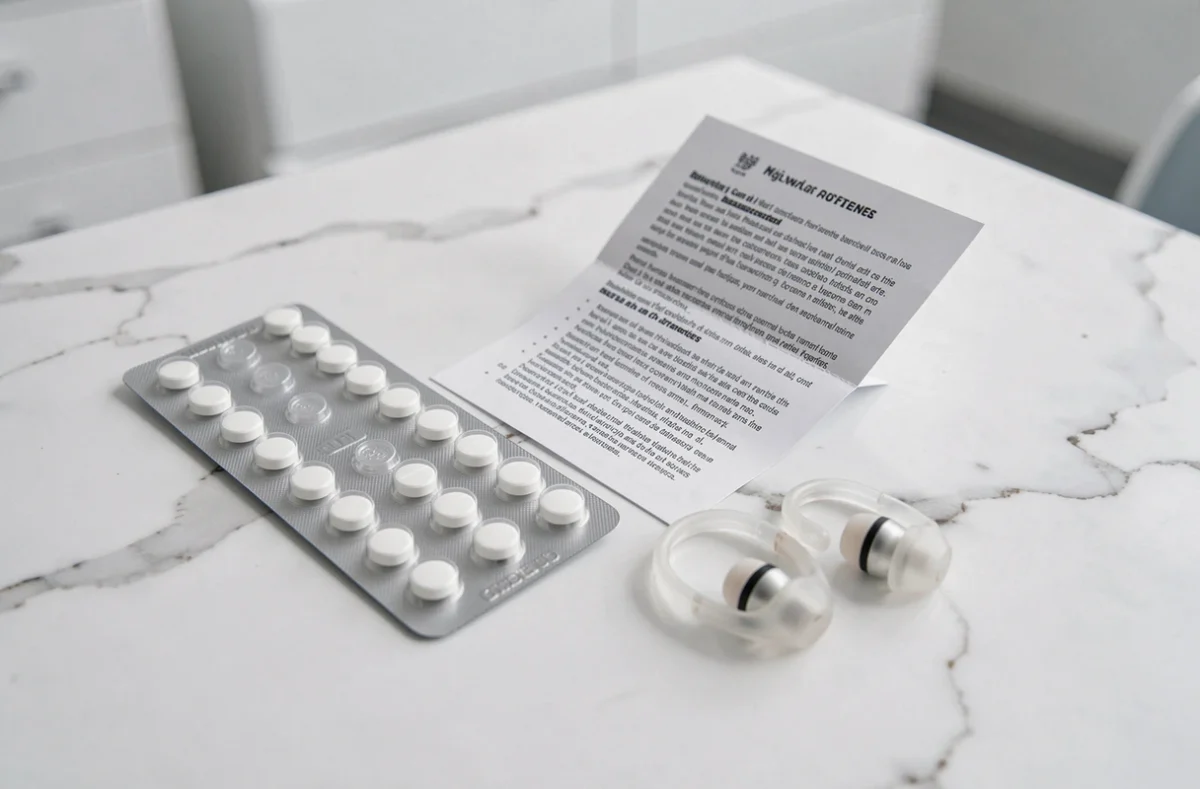
Day and Night formula: a dual format that complicates monitoring
Audistim comes in two versions: Day and Night. The Night version contains melatonin to promote sleep onset, while the Day version relies on other plant extracts.
This dual format creates a difficulty rarely addressed. When taking two different formulas of the same supplement, monitoring doses and interactions becomes more complex. The treating physician or pharmacist may not always be aware of all the products consumed.
Feedback varies on this point: some users report a subjective improvement in sleep, while others notice no change in the tinnitus itself. The placebo effect, well documented in subjective disorders, may explain part of these positive testimonials.
Persistent tinnitus: when to consult an ENT rather than seek a supplement
The most insidious danger of Audistim is neither an interaction nor a direct side effect. It is the delay in care that it can cause.
A persistent tinnitus may signal hearing loss, an acoustic neuroma, or a vascular pathology. By first turning to a dietary supplement, one may delay an ENT consultation by several months that could have allowed for early diagnosis.
Signals that require immediate consultation:
- Unilateral tinnitus (one side only), which may indicate a condition requiring imaging
- Pulsatile tinnitus, synchronous with the heartbeat, suggesting a vascular cause
- Sudden hearing loss associated with ringing, considered an ENT emergency
- Tinnitus that appeared after recent sound or head trauma
Taking Audistim does not pose a vital danger for most users. The problem lies elsewhere: a supplement without proven efficacy that delays a real diagnosis costs time, and sometimes chances of auditory recovery. Before opening a box of supplements, opening the door to an ENT office remains the most reliable approach.