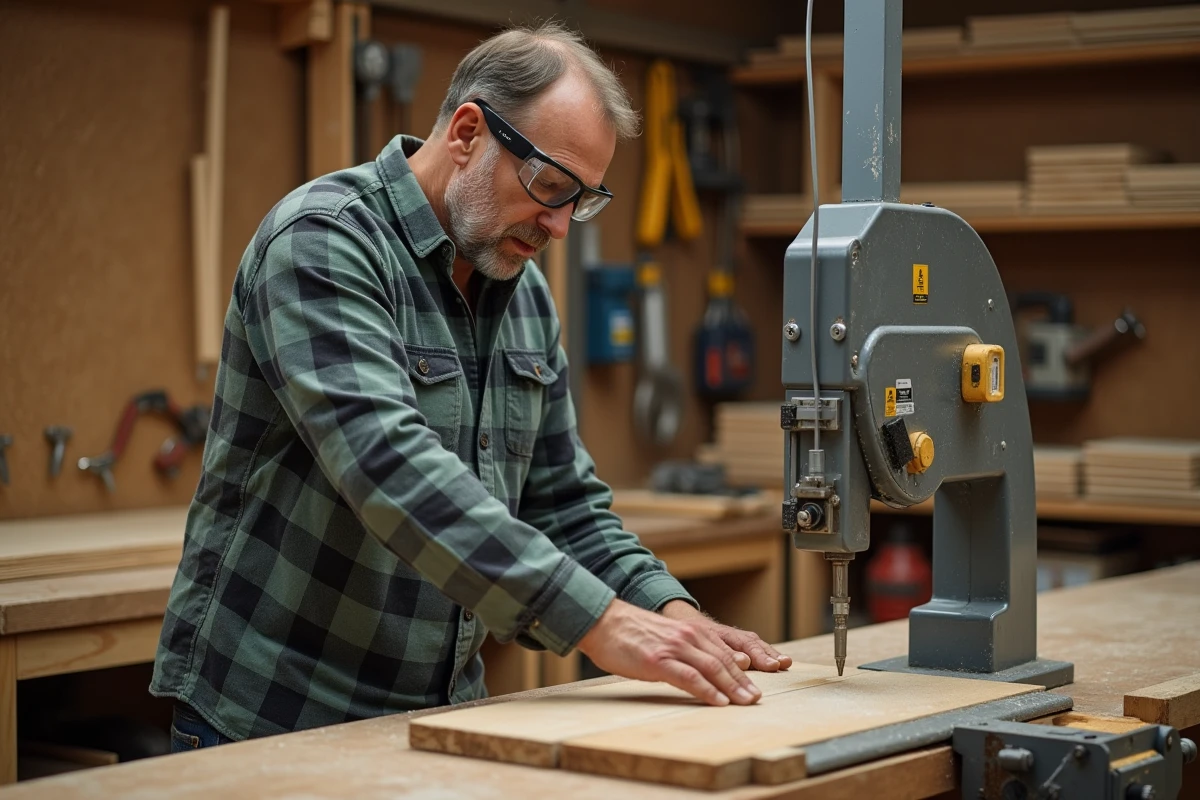
You place a parquet board against the guide of your saw, lower the cutting head, and the line goes off track. The problem doesn’t stem from your action, but from the type of machine. Radial saw or miter saw, the choice affects precision, cutting width, and even your safety. Understanding what separates these two tools helps avoid unnecessary purchases and imprecise cuts.
Vibrations and stability: the unknown risk of cheap radial saws
When you pull the carriage of a radial saw towards you, the blade travels across the entire width of the piece. This translational movement amplifies vibrations if the slides lack rigidity. On an entry-level model, the mechanical play in the rails creates a beating phenomenon that you feel directly in your hands.
This beating has two consequences. The first is visible: the cut deviates by a few millimeters, especially on angled cuts at 45°. The second is less obvious: muscle fatigue accumulates, and concentration decreases after a series of repeated cuts.
Professional carpenters report on the ProMenuisier.fr forum a decrease in the smoothness of the slides after about 500 hours of intensive use on entry-level Scheppach models, requiring frequent lubrication. To better understand the difference between radial saw and miter saw, this point of mechanical reliability should be considered before any budget.
The European directive 2024/1234 now regulates the vibration levels transmitted by power tools. The cheapest models do not always mention their vibration values in the technical sheet. Checking for this data before purchase is a simple reflex that protects your joints in the long term.

Miter saw without a carriage: for which cutting tasks
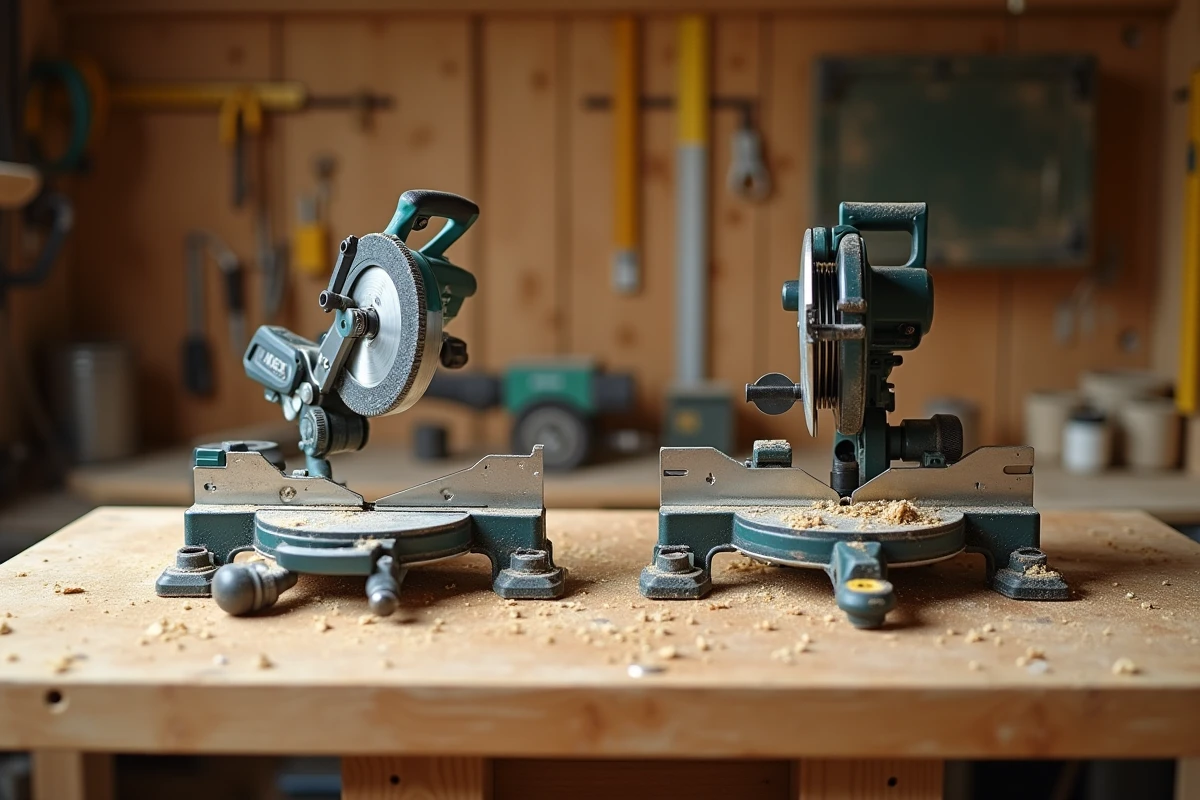
A classic miter saw operates on a pivoting axis. You set the angle, lower the head, and the blade descends vertically into the piece. No lateral translation, so much less mechanical play.
The downside is the cutting width. Without a carriage, the cutting capacity generally does not exceed 140 mm. This is sufficient for:
- Baseboards, corner strips, and moldings, whose section rarely exceeds 100 mm
- Small-section battens and rafters used for the framework of partitions or shelves
- Frames and decorative assemblies that require clean 45° miter cuts without rework
Are you installing baseboards in an apartment or assembling a solid wood piece of furniture? The simple miter saw covers most of these needs with superior precision because the mechanics remain straightforward. Fewer moving parts mean fewer sources of inaccuracy.
Radial saw: when cutting width becomes the decisive criterion
The radial saw adds a sliding carriage to the cutting head. This carriage allows the blade to move horizontally, increasing the cutting capacity to about 320 mm depending on the models.
Are you working with wood panels, laminated countertops, or wide decking boards? This is the domain of the radial saw. The carriage also makes repeated crosscuts on thick pieces possible, a frequent need in framing or layout work.
The wider the cutting width, the more the rigidity of the frame matters. A lightweight aluminum frame on a cheap model flexes under lateral cutting force. The result: a line that flares at the end of the cut. Mid-range and high-end models use sealed bearing slides and a more robust frame, which limits this defect.
Motor power and blade type: two related variables
Power alone doesn’t say much. A high-power motor paired with an unsuitable blade produces more heat and splinters than a moderate motor with the right tooth configuration.
For raw wood (rafters, formwork boards), a blade with alternating teeth and few teeth cuts quickly and evacuates chips well. For fine cuts on hardwood or laminate, a trapezoidal tooth blade with a higher number of teeth produces a clean line without splintering.
- Softwood and fast cuts: alternating tooth blade, fewer teeth
- Hardwood, laminate, or melamine: trapezoidal blade, tight tooth configuration
- Aluminum (profiles, angles): specific negative tooth blade, suitable for non-ferrous metal
- Versatile mixed cutting: combined blade, a compromise between speed and finish
Changing the blade takes less than five minutes on most recent models equipped with a spindle lock. Having two blades (one fast, one fine) costs less than buying a second saw.
Wear of the slides and maintenance: what the purchase price doesn’t show
The real cost of a radial saw goes beyond its store price. The slides of the carriage are the main wear part. On an entry-level model, they lose smoothness much faster than advertised, especially if wood dust accumulates in the rails.
Regular maintenance (dusting after each session, periodic lubrication of the rails) extends the machine’s lifespan. Neglecting the lubrication of the slides degrades precision even before the blade dulls. This maintenance reflex rarely appears in consumer buying guides.
On a miter saw without a carriage, this problem does not exist. The pivoting axis requires little maintenance and retains its precision for a much longer duration.
The right choice depends on the widest piece you cut
Measure the maximum width of the materials you regularly cut. If it remains under 140 mm, the simple miter saw offers more precision, less maintenance, and a lower price. Beyond that, the radial saw becomes necessary, provided you invest in a model whose slides and frame stand the test of time.
A well-sized tool for your actual work is always better than a mediocre multipurpose machine. The budget question is not between the cheapest and the most expensive, but between what cuts accurately for years and what will vibrate from the first winter in your workshop.