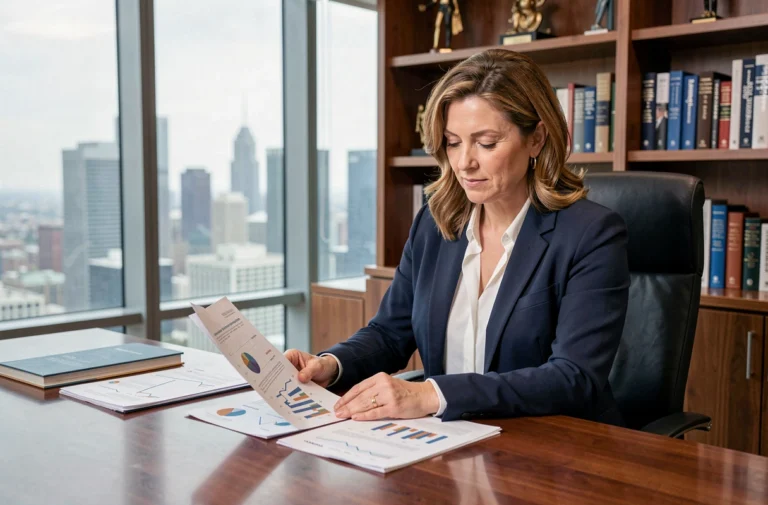
Wall Street is often perceived as a male bastion, dominated by iconic figures in finance. However, behind every great man are powerful and influential women who play a fundamental role in their success. These women, whether they are wives, business partners, or mentors, provide invaluable and often invisible support.
Their influence extends beyond the private sphere; they actively participate in strategic decisions and professional directions. By valuing their contributions, we uncover a lesser-known but essential facet of the financial world, where talent and perseverance come together in a feminine way.
Influential Women of Wall Street: Inspiring Journeys
The rise of influential women in Wall Street finance is exemplary. Audrey Choi, CSO of Morgan Stanley, is the first Chief Sustainability Officer on Wall Street. A graduate of Harvard Business School, she founded the Institute for Sustainable Investing and the Global Sustainable Finance Group. Before joining Morgan Stanley, she worked for the Clinton administration and The Wall Street Journal.
Mary Callahan Erdoes, CEO of J.P. Morgan Asset & Wealth Management, is another prominent figure. Also a graduate of Harvard Business School, she led J.P. Morgan Private Bank before taking the helm of Asset & Wealth Management. Her career includes positions at Bankers Trust and Stein Roe & Farnham.
Jane Fraser, the first female CEO of Citigroup, was ranked the 10th most powerful woman in the world by Forbes in 2022. A graduate of Cambridge and Harvard Business School, she held positions at Goldman Sachs and McKinsey & Company before joining Citigroup.
Virginie Morgon, chairwoman of the board of Eurazeo, was the youngest managing partner at Lazard. Educated at Sciences-Po Paris and Bocconi University in Milan, she embodies the new generation of female leadership in finance.
These journeys showcase the diversity of experiences and contributions of these women. The presence of figures like Denise Lombardo, though less publicized, illustrates the discreet yet essential support they provide. Each of these paths demonstrates that women are key players in the transformation and innovation of the financial sector.

The Challenges and Contributions of Women in Finance
The women who have reached the highest levels of finance have had to overcome considerable challenges. Their journeys are often fraught with obstacles such as the glass ceiling and gender biases. Their resilience and expertise have led to significant contributions to their institutions.
Examples of Major Contributions
- Audrey Choi: first Chief Sustainability Officer on Wall Street, founded the Institute for Sustainable Investing at Morgan Stanley.
- Mary Callahan Erdoes: CEO of J.P. Morgan Asset & Wealth Management, led J.P. Morgan Private Bank, contributing to the management of several billion dollars in assets.
- Jane Fraser: first female CEO of Citigroup, ranked 10th most powerful woman in the world by Forbes in 2022.
- Virginie Morgon: youngest managing partner at Lazard, chairwoman of the board of Eurazeo.
Diverse Journeys
The journeys of these women show remarkable diversity. For example, Laura Pedersen became the youngest trader to secure a desk at the American Stock Exchange, enriching her clients by nearly $5 billion. Meredith Whitney predicted the state of American banks in 2007, leading to the creation of Meredith Whitney Securities.
Leadership and Vision
The leadership of Hillary Clinton, the first female candidate for the presidency of the United States, and Joëlle Durieux, managing director of the Finance Innovation competitiveness cluster, shows that women’s contributions extend beyond the financial sector. The vision of Ariane de Rothschild, chairwoman of the executive committee of the Edmond de Rothschild group, has adapted banking to new regulations.
These examples illustrate women’s ability to transform and enrich the financial sector, despite the obstacles they face. Their influence continues to grow, changing the traditional dynamics of Wall Street.