
In France, the French Cycling Federation oversees the majority of road, mountain bike, and cyclo-cross events. However, it is still possible to participate in a cycling race without holding an annual FFC license, provided one is aware of the provisions set by the federation and the alternatives offered by other organizers. The regulatory framework has evolved in recent years, with the introduction of open formats and temporary participation titles that broaden access to competition.
FFC Discovery Pass: the temporary title to race without a club
The least known provision for cyclists not affiliated with a club is the Discovery Pass. This participation title, issued directly by the FFC, functions like a temporary license. It is open to everyone, starting from 17 years old, fully digital, and can be activated online from the federation’s licensed area.
Its validity period is 30 days from the subscription. During this time, the holder can register for competitions listed on the FFC calendar, across all disciplines (road, mountain bike, cyclo-cross, gravel). The Pass includes insurance coverage, a point often overlooked by occasional participants.
For cyclists looking to find out how to obtain an FFC license without a club, this Pass is the most direct entry point. The procedure boils down to creating an account on the federation’s website, following the instructions, and receiving the license card via email.
However, the Discovery Pass has a structural limit: it is meant to assess one’s level and test competition, not to participate in races throughout the season. Beyond the validity period, the federation directs individuals towards an annual license, either individual or club-based.
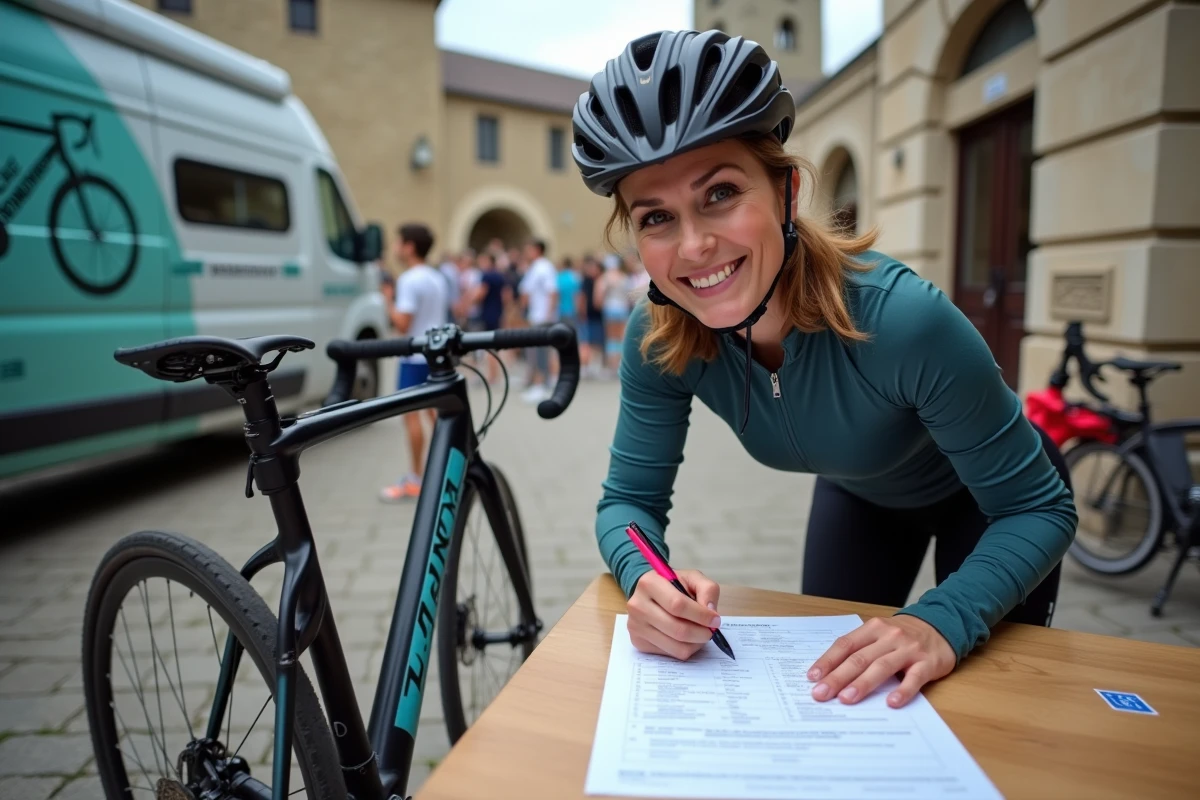
Medical certificate and insurance: often underestimated obligations
Whether it is a Discovery Pass, a day license, or registration for an open cyclosportive, a medical certificate is required in almost all cases. This document must attest to the absence of contraindications to competitive cycling. Its issuance date should generally not exceed one year.
The issue of insurance deserves particular attention. The FFC’s civil liability guarantee only covers holders of a valid license or Pass, and only for events listed on its calendar. For non-licensed participants engaged in cyclosportives or “open” events, the organizer must take out a specific policy, but this coverage may have exclusions (activities outside the course, capped compensation amounts).
The FFC recommends that occasional participants check if they have a “private life” civil liability and an individual accident insurance covering competition. In the event of a fall in an event where one is not covered by either the federation or the organizer, medical expenses remain the responsibility of the racer.
Documents to gather before race day
- A medical certificate of no contraindication to competitive cycling, dated within the last year
- A valid identification document, often required when picking up the race number
- Proof of subscription to the Discovery Pass or day license (digital card sent by email)
- A civil liability insurance certificate covering competitive practice, if required by the organizer as a supplement
Events outside the FFC calendar: UFOLEP, FSGT, and open gravel formats
The landscape of cycling races is not limited to the FFC. In recent years, several affinity federations and private organizers have developed formats accessible without a federal license.
The UFOLEP has expanded its road and mountain bike calendar with “public access” events where a day license is sufficient. The FSGT offers a similar operation, with categories open to non-licensed participants upon presentation of a medical certificate. Gravel and ultra-distance events, often organized by private entities, frequently accept registrations with just a medical certificate without requiring any federal license.
These formats present an advantage for the occasional cyclist: the registration process is simplified, and the entry cost remains limited to the day license or registration fees. However, the level of insurance coverage varies significantly from one organizer to another. Feedback from the field differs on this point, with some organizers including comprehensive insurance in the registration fee, while others limit it to the strict minimum required by regulations.

Individual FFC license or Discovery Pass: which choice depending on race frequency
The FFC offers two types of annual individual licenses (outside of clubs): the Sport license, oriented towards leisure, and the Competition license, which grants access to all events on the federal calendar. These licenses cover all cycling disciplines with a single document, from mountain biking to cyclo-cross, including road and BMX.
For a cyclist considering one or two races in the year, the Discovery Pass remains the most suitable choice. The cost and commitment are minimal, and the insurance coverage is sufficient to test competition.
Beyond three or four participations per season, the annual license becomes more coherent, both financially and practically. It removes the constraint of renewing a Pass every 30 days and provides access to preferential rates for certain events starting in the 2025 season, according to the FFC.
The individual license also allows for category changes during the year (moving up, down, or adding a discipline) by contacting the departmental committee. The Discovery Pass does not allow for these adjustments.
The choice thus depends on a simple criterion: the regularity of competitive practice. For occasional participation, temporary provisions are sufficient. For a structured season, the annual license offers a more stable framework, even without club affiliation.